Monday, 27 July 2015

ARE CEOs AND HR READY FOR ROBOTIC AUTOMATION?


Pulse on
robotics


The robots are coming: Are CEOs and HR) ready for the era of automation?

If there’s one theme that CEOs stress time and time again, it’s the potential of new technology to drive innovation and business growth. This belief has already been validated through the transformative power of the internet and mobile. Could robotics have the biggest technological influence of them all?
There’s often a tendency to frame robotics either in terms of superhuman intelligence – think shiny walking things taking control of the human race - or, at the other extreme, as mere mechanical replacements for blue collar assembly jobs. The reality, however, is somewhere in the middle: increasingly robotics is assuming a more cognitive role – incorporating an element of decision-making once the sole preserve of human employees.
While robotics may still be a long way off world domination, this technology has already moved past the point of simply substituting existing human roles to the beginnings of an augmented and collaborative working model alongside people – what we call the ‘blended workforce’.
In this latest ‘pulse’, we explore CEOs’ current perceptions of how robotics in the workplace is shaping their businesses today and in the near future. We also offer our perspectives on how robotics and automation have the potential to be truly transformative in the way they create value within organisations.
The here and now
Significant leaps have been made since the first industrial robot was introduced some 50 years ago. Companies today are spending billions on robotics and intelligent automation. They range from basic tasks such as cash machines in banking, self-service check-outs in retail and airport check-ins - to complex industrial robots such as those employed on the car assembly line, robot butlers being trialed in hotels, customer-service androids being used in banks (such as Bank of Mitsubishi's multi-lingual Nao robot), and the drones being prototyped to deliver our groceries. Investment in robotics continues to grow: venture capital companies committed around $172 million in 2013 while technology leaders are already buying into robotics technology.
The here and now for CEOs

Role of robotics in IT, customer service and sales to grow significantly
1. Beyond manufacturing. According to PwC’s The New Hire: How a new generation of robots is transforming manufacturing, an estimated 1.5 million robots currently bustle on assembly lines around the world. So, it’s not surprising that the majority of CEOs we talked to cite manufacturing and production as the key functional area where they’ve already adopted robotics in their organisations or plan to do so in the next five years. But, increasingly, other areas of the business will also feel the robotic touch: CEOs identified IT, sales and customer service as areas where robotics will play a role in the near future.

“I see robotics as a consistent way of saving cost and having more efficient processes, especially in the logistics and operational areas.”
Industrial Products CEO, Latin America

2. Positively productive – CEOs are upbeat about the productivity of robotics. CEOs agree that robotics is going to make their companies more efficient, with 94% of those who’ve already adopted robotics saying that it’s increased productivity in their business. That’s not a surprise given that robots are already proving to be more cost effective and more productive workers than humans. In some fields, such as manufacturing and the military, their speed, strength, resilience and lower error rate make them ideal for working in dangerous surroundings or ‘round the clock’.
“I think robotics will be useful in manufacturing. It will reduce headcount significantly…and the quality of production will be clearly predictable.”
Industrial Products CEO, Asia Pac

3. Robotics as a driver of innovation. The speed of advances in robotics has completely outpaced that of improvements in human productivity. So, it’s likely that the real gains from this technological leap may not only come in improving existing business functions, but in the new business models and new roles that robotics could create. 64% of the CEOs we surveyed told us that robotics will bring new innovations to their business models.


4. Halcyon Days with Hal 9000? Over the next five years, CEOs expect that almost a fifth of their workforce tasks will have an element of robotics to them. Whether this will be pure substitution (58% of them also tell us they intend to reduce headcount because of robotics over the same time frame) or finding new ways of working collaboratively, it’s hard to say.
Indeed, it’s impossible to take a clear look at the impact robotics will have on business without wondering about the fate of the workforce as we know it. Some industry pundits are aggressive in their forecasts as to the extent to which robotics and computerisation in general will impact the workforce. For instance, Oxford University has estimated that, by 2034, robotics and other computerisation could replace 47% of jobs in the US.


Certainly, we believe we’ll see greater collaboration between man and machine as robotics paves the way for more sophisticated ‘augmented’ workforce models. For example, Amazon recently announced the deployment of 15,000 Kiva robots to its US fulfillment centres to make sure no time is lost in dispatching customer deliveries. So, what’s the right blend of human and ‘robot’ employees and how will organisations effectively rescale in this new world?
The big employment debate
Do companies need to prepare for a time when they need just a handful of people blended with hundreds or thousands of machines? And do employees need to panic? Probably not. Erik Brynjolfsson and Andrew McAfee, authors of the Second Machine Age argue that ‘smart machines’ don’t necessarily equal ‘unemployment’. They posit that technology will simply create different kinds of work (echoing the sentiment of Keynes’ on technological unemployment). Interpreting the rise of robotics only in terms of direct job losses misses the point of how robotics can also create new jobs and opportunities for workers. It could achieve this by handing off the traditionally low-paid, low-skilled jobs to the bots while freeing workers to pursue alternative or more rewarding career paths. There might be less demand for factory workers but more demand for machine maintenance or programmers.
Evolution of the customer service-bot
We already see that self-service and automation have become business as usual for interacting with customers in sectors such as retail - think self-service supermarket checkouts or self-service check-in and bag drop at airports. That’s just that the start. Teams of smart robots helping with these self-service check-ins or checkouts could be the next stage of automated customer service. Take Geneva airport, for example: not so long ago they trialed mobile robots to direct passengers to services such as currency exchange, toilets and rail connections. Or, Lowes, the US home improvement store, that’s been experimenting with robots to help customers locate items in the store. But, could robotic customer service be more of a hindrance than a help? While the bots might have the upper hand in terms of accuracy, performance and resilience to cope with dull and repetitive tasks, how capable are they of providing a ‘human touch’ or ‘going that extra mile’ – both arguably the secrets to customer service success?
The journey from automation to augmentation
To what extent though will robotics, particularly with the advances in artificial intelligence, also put highly skilled workers out of jobs? 69% of the CEOs we spoke to disagree with that notion but, surely, much will depend on the extent to which thinking (or cognitive) tasks can be automated or ‘delegated’ to robots. Some tasks – those that rely on intuition or leaps of faith, for example - will always be more suited to people. Others – those that are improved by speed, precision or big data - are best suited to machines or automation. Early automation efforts focused on taking thinking responsibilities from employees and putting them into systems. Take the world of credit, for example. Once upon a time a bank manager looked at your reputation, your family, and assets in the bank, among other factors, to arrive at a decision. Today, a credit-scoring algorithm rates you then determines the amount of credit the lender is willing to give. A lending process that was, at one time, completely unstructured is now fully structured and automatable. Which means the bank manager has to migrate on to some other task. Organisations will always be riding that wave of what’s automatable and that wave is always crashing into new shores.
As robotics becomes more integrated throughout the business, employers are going to have to invest in reskilling many parts of the workforce to adapt to working alongside and managing robotic processes and even colleagues. In the healthcare sector, for example, doctors will need to be both expert interpreters of data or communicators with their patients as well as being known for simply their technical skills.

“I think the field of robotics will be able to make a breakthrough in the intellectual function of robotics as well as the physical function.”
Financial Services CEO, Middle East

The challenges for robotics
As the ability and role of robotics grows, companies will be forced to confront a series of issues that may still feel a bit like science fiction.
In this CEO pulse, we’ve focused on the impact robotics will have on the workforce, but its influence on areas like asset intensity, energy use or location of taxation may well be equally important. As companies start to automate processes and/or introduce more artificial intelligence into white collar ‘thinking’ tasks (like knowledge management, analytics, business services and law) this new automated knowledge workforce will pose real problems for companies in terms of insuring against risk (for instance software crashes, cyber-attacks or systemic fragility) and protecting intellectual property.
It’s not just a challenge for business. There’s likely to be a growing uneasiness among trade unions, governments and regulators as robotics becomes more widespread. You can throw into that mix a potential disquiet from society about the increasing dominance of robotics and automation. In a recent PwC poll of global consumers, 25% of those surveyed thought that robotics would have a negative impact on society. However 58% said this impact would be positive, with higher positivity coming from BRIC countries.


The happy marriage between man and machine
At present, the true transformative power of robotics still seems alien to many. The same was true with digital media, big data and the internet of things (albeit early days). And yet those technological trends are transforming how we live and work. Certainly, the technology that’s come before made certain ways of working and living obsolete. More often, though, new technology has augmented our everyday experiences – think how mobile technology and smartphones have revolutionised the way we communicate, or how second screens and social media have made live TV more relevant and compelling. Robotics will, sooner or later, be incorporated into our business and home life. Could it be that 25 years from now, robotics will be as an essential and integral part of our life as the internet is today?

Final thoughts

  • What’s the perfect blend of man and machine? What areas of work can be automated?
  • Who in your organisation is responsible for robotics and automation?
  • Robotics will reshape your workforce. How can you take advantage of that change to direct talent to the right parts of the business?
  • Automation brings with it great efficiencies, but a number of business risks. How does your risk and resilience strategy take robotics into account?
  • How could robotics drive innovation in your business?
  • Are you a manufacturing CEO? If so, find out if robotics is right for you by taking our ‘robot-ready self-assessment’.

Methodology
PwC’s CEO pulse provides a temperature gauge of global CEO sentiment on a variety of topical business issues throughout the year. For this pulse on robotics we spoke to 140 CEOs across Europe, Latin America, Asia Pacific, Africa, North America and the Middle East in the summer of 2014. At the same time, we polled 1,200 consumers from the United States, United Kingdom, Germany, Spain, India, Brazil, Russia, Mexico, Canada, Australia, China and Sweden for their perspectives on the same topic.
Note:
Definition of robotics: the scope we gave to pulse CEOs. We probably all have a certain image in our minds of what a robot is. But we asked CEOs to think of robotics in the broadest sense; from those that are capable of carrying out physical tasks in place of humans (in areas such as manufacturing, earth and space exploration, surgery or the military in a pre-programmed automated fashion) through to those with a degree of artificial intelligence that are capable, or will be capable in the near term, of adapting to their environment and continuously learning to perform ‘white collar’ complex thinking or decision-making tasks.

Wednesday, 10 June 2015

VACANCY FOR FRONT DESK EXECUTIVE(URGENT)


FRONT DESK EXECUTIVE


A manufacturing company located in Ketu-Lagos requires the service of a Front Desk executive.

Key Responsibilities

§  To perform front desk administrative duties and other good customer care services to both internal and external clients.
§  To collaborate with security personnel on control of access and adherence to procedures.
§  To provide general help desk services.
§  To receive and direct visitors.
§  To maintain a front desk visitor’s register.
§  To deliver internal mail and personal documents services
§  To perform any other duties as may be assigned from time to time.

Skills and Abilities
§  Customer care, communication and public relations skills.
§  Articulate, cordial, hospitable and pleasant personality
§  Good telephone etiquette
§  Good people management and interpersonal.

Qualifications and requirements

§  Minimum of an Ordinary National Diploma certificate in Secretarial studies, Business Administration e.t.c.
§  Age from 21 years and above.
Good knowledge of Microsoft Office packages.
§  Minimum of two (3) years relevant work experience.
§  Applicants are required to be resident in Lagos.

Applications with attached curriculum vitae, cover letter and copies of credentials should be sent to:  recruitment@wemydrbrowns.com not later than Friday 26th of June 2014.

DATAFICATION OF HUMAN RESOURCES

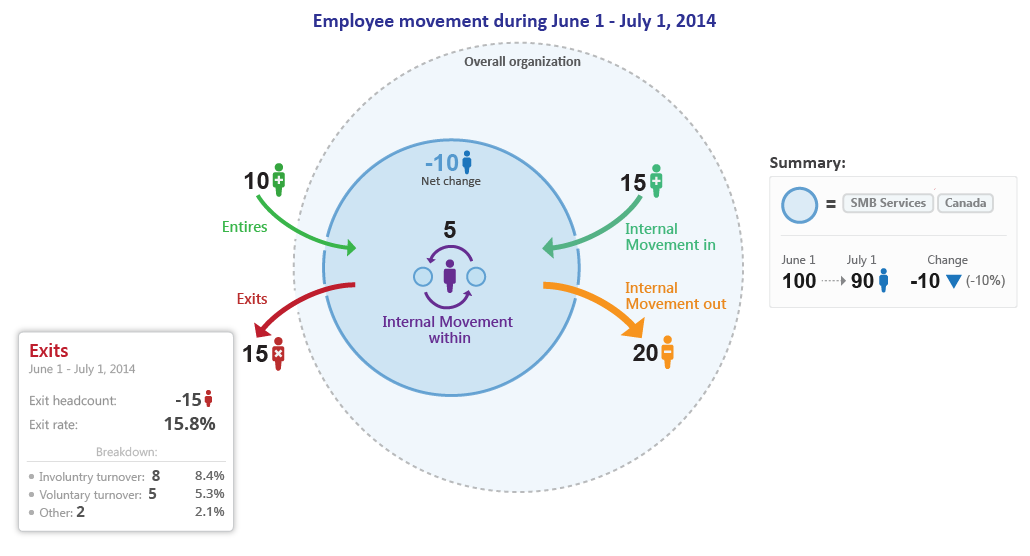
Datafication is a new term used to describe the process of turning an existing business into a “data business.” In HR it refers to our increasing ability to use Talent Analytics to understand more and more about our people, HR practices and processes, and external demographics.
Global competition for talent, outsourcing labor, compliance legislation, remote workers, aging populations – these are just a few of the daunting challenges faced by HR organizations today. Yet the most commonly monitored workforce metrics do very little to deliver true insight into these topics. Leaders need to graduate from metrics to analytics, surfacing the important connections and patterns in their data to make better workforce decisions.
Visier-Workforce-Analytics-Employee-Movement
Learn the difference between metrics and analytics, as well as key analytics and their values in these core areas:
  • Recruiting Effectiveness
  • Performance
  • Talent Retention
  • Employee Movement
  • Total Rewards
The challenges in today’s business environment require new approaches to remain competitive in an ever-shrinking world of global competition. By graduating from metrics to analytics, HR professionals and leaders can better understand the contributing factors that are impacting their organization, and take the right actions to implement programs that will provide a true competitive advantage.
Learn how you can graduate from metrics to analytics with this informative paper.

Monday, 18 May 2015

JOB OPENING: HEAD OF MARKETING AND SALES


MANAGERIAL OPENING: Head of sales and marketing for a fast growing Indigenous Manufacturing Company


Head of sales and marketing position is responsible for planning and implementing sales, marketing and product development programs, both short and long range, targeted toward existing and new markets by performing the following duties personally or through subordinates.


Essential Functions

Develops and implements strategic marketing plans and sales plans and forecasts to achieve corporate objectives for products and services.

Develops and manages sales/marketing operating budgets.

Plans and oversees advertising and promotion activities including print, online, electronic media, and direct mail.

Develops and recommends product positioning, packaging, and pricing strategy to produce the highest possible long-term market share.

Achieves satisfactory profit/loss ratio and market share in relation to pre-set standards and industry and economic trends.

Ensures effective control of marketing results, and takes corrective action to guarantee that achievement of marketing objectives falls within designated budgets.

Oversees and evaluates market research and adjusts marketing strategy to meet changing market and competitive conditions.

Monitors competitor products, sales and marketing activities.

Establishes and maintains relationships with industry influencers and key strategic partners.

Guides preparation of marketing activity reports and presents to executive management.

Establishes and maintains a consistent corporate image throughout all product lines, promotional materials, and events.

Directs sales forecasting activities and sets performance goals accordingly.

Directs staffing, training, and performance evaluations to develop and control sales and marketing programs.

Directs market channel development activity and coordinates sales distribution by establishing sales territories, quotas, and goals.

Represents Company at trade association meetings to promote product.

Meets with key clients, assisting sales representative with maintaining relationships and negotiating and closing deals.

Coordinates liaison between sales department and other sales related units.

Analyses and controls expenditures to conform to budgetary requirements.

Assists other departments within organization to prepare manuals and technical publications.

Prepares periodic sales report showing sales volume, potential sales, and areas of proposed client base expansion.

Reviews and analyses sales performances against programs, quotes and plans to determine effectiveness.

Directs product research and development.
Competencies

Business Acumen.
Communication Proficiency.
Customer/Client Focus.
Leadership.
Presentation Skills.
Problem Solving/Analysis.
Results Driven.
Knowledge and experience of North/South/East and Western Nigeria
Strategic Thinking.
Technical Capacity.
Supervisory Responsibility.
Experience in FMCG business – Minimum   10 years

This position manages all employees of the department and is responsible for the performance management and hiring of the employees within that department.

Work Environment
This job operates in a professional office environment. This role routinely uses standard office equipment such as computers, phones, photocopiers, and filing cabinets 


Basic Remuneration and benefits: 


Between 9- 11 million Naira PA
Yearly bonus income available on achieving sales and profit targets
Heath Insurance, and a brand new company car- comes with the position

How to apply:

Comment on the blog and send your detailed CV accompanied with a well written covering letter, giving details why you are the best person for the role. Please application send to: recruitment@wemydrbrowns.com. Do quote 'Talent Managers' as the source in your covering letter.

Expires :

22/05/2015

Thursday, 7 May 2015

7 WAYS TO BECOME AWESOME IN HUMAN RESOURCES


SEVE (7) IN WAYS TO BECOME AWESOME IN HR

by Alan Collins
When you gain a reputation as someone who is awesome in HR, a lot of things become irrelevant.
It won’t matter how much HR experience you have.
It won’t matter what college you went to.
It won’t matter what degree you have.
It won’t matter whether you’re HR certified or not.
No one will give a crap about that stuff.  Instead, they will be spellbound by your awesomeness.
You will face fewer obstacles in your climb up the ladder of success.
And no one ever forgets the experience of working with this type of HR pro.
So, how do YOU become awesome?
Here’s how:

1. Stop making excuses and start taking responsibility.

No one wants to hear why you couldn’t do something. So make a conscious decision right here, right now to stop awfulizing and giving excuses.
Grab responsibility by the throat, wrestle it to the ground and own the results of the projects you work on.
When something goes wrong (and it usually does), own that too.
Don’t blame the CEO.
Don’t blame your boss.
Don’t blame your clients.
Don’t blame your team members.
Don’t blame “the culture.”
If you aren’t comfortable with this mindset, it will be hard for you to build an HR reputation for being awesome. “Average” HR people quickly make up excuses and point fingers at other people or situations when things don’t go as planned.
They’ll criticize the “design” of the new performance appraisal program rather than work with their clients to customize it to make it work.
They’ll blame the high turnover in their client groups on the lack of a company-wide onboarding program, rather than take steps to create one themselves.
Remember this: no statue was ever erected to honor a critic.  You can’t be awesome if you prefer spending your time on sidelines booing those on the playing field, rather than trying to make a difference yourself.

2. Work your ass off.

Yes, worklife balance and taking time off to rest are important.  But those are things you do AFTER you’ve created your HR awesomeness.
It’s impossible to become awesome if you’re playing World of Warcraft every night or rushing home to catch the latest episode of Broke Girls.
You’ve no doubt heard this before: “If you want to get something done, ask a busy person to do it.”
To be awesome, you must become recognized as that busy person who gets things done.

3. However, learn how to say no.

One of the quickest ways to rise in HR is by saying yes.
Yes, I’ll take on this new project.
Yes, I’ll work through the weekend to get the employee engagement survey results analyzed for that big presentation.
Yes, I’ll tackle the compensation project that’s outside of my comfort zone.
But in doing this, don’t be a doormat for people to step on.
If you truly say yes to everything, you’ll quickly burn yourself out, and then you won’t be producing your most creative or innovative work. The work that will truly separate you from the rest of the pack.
What’s more, you’ll overcommit yourself and disappoint your boss or team members when you can’t meet deadlines or complete all that you’ve said you’d do.
So instead of saying yes all the time, learn how to accurately estimate long a project will take and balance that against the other tasks currently on your plate. Then, learn how to give polite but firm NO’s when necessary, a compromise or other options.
For example, if the boss asks for a time-consuming project to be done on an impossibly short deadline, you might say, “Getting you the talent review summaries for all 40 sales locations by Monday isn’t doable given the other priorities on my plate.  But I CAN get it to you by Wednesday at noon, or by Tuesday morning if I can borrow a colleague to help me out.”

4.  Over-deliver in your personal relationships.

In any given work environment — including HR — almost everyone is focused on one goal: to make themselves look good.
If you can change things around and focus on making other people look good, you’re well on the way to being awesome.
Being known as a backstabber, brown-noser, boot-licker or a self-centered jerk is not a recipe for awesomeness.
Instead, give others more than you get. Never find yourself in relationship debt. From time to time, you’ll screw up. When that happens, apologize like this:
“I’m really sorry. It was completely my fault. I hope you’ll forgive
me, and here is how I am addressing this in the future.”
Buy thank-you cards and write 2-3 every day. Use your calendar to keep up with the birthdays of as many people as possible. Write real birthday notes or cards instead of e-mail messages. .
Whenever a casual or business relationship is coming to a close (the training class ends, colleagues move to another project, etc.) write the person a quick email. “I enjoyed working with you… thanks for doing a nice job.”
When bad things happen to others, be quick to forgive the following: mistakes, weaknesses, shortcomings. (No one is exempt from these things, even awesome people.)
However, you should worry about the following: dishonesty, passive aggressive behavior, chronic tardiness, whininess. (These patterns do not usually get better with time.)
Radically exclude people that waste your time. This is NOT being impolite – it is showing respect for the people you have committed to serve.
Remember that people will basically act the same no matter who they are around. If the people you hang out with are always complaining about other people, chances are they probably complain about you too. The point is: don’t put others down when they’re not around, or at least make sure you’re comfortable with whatever you say being repeated.

5. Take charge and lead when no one else will.

Here’s an example. From time to time you’ll arrive at a meeting where it’s not clear who is in charge. An example is a meeting to launch a new HR initiative which includes colleagues of equal rank. Here is how to handle this:
Step 1: Assess the situation to determine the leadership skills of the other attendees. Remember that your goal is to get things done and make other people look good.
Step 2: Take initiative without taking control. Be helpful, ask questions, and offer to accept tasks on behalf of the group.
Step 3. At the end of the meeting, provide a quick recap based on the actions the group agreed to. “OK, so Susan will contact the Legal Department, I’ll do the research and contact Finance…” and so on.
Step 4. If no one else is openly taking notes, do it yourself. Type them up and email them out to the participants within 24 hours of the meeting to “ensure we’ll all on the same page.”
A Note on Notes: being the recorder accomplishes two things. 1) You are viewed as awesome for taking the initiative and capturing information for everyone else, and 2) You get to put your own bias on how the notes are written.
You can apply this mentality to bigger meetings as well if there isn’t a project manager or meeting leader to do this for you.

6.  Enlarge your vision of success.

Work on creating larger, more compelling goals. Take what’s already working well in your HR career and exponentially add to it.
Grow your professional HR network by 300%.
Apply for positions two levels above your current role.
Identify five HR mentors instead of one.
The funny thing about big goals is that they often take less time to achieve than you expect. And even if you fall short (which you often will), you’ll learn faster and wind up far ahead of where you expected.

7.  Get help from others.

As you pursue your plans for complete and total awesomeness in HR, you’ll be naturally drawn to others who have made the same decision.
Even better, those that “get it” will be drawn to you as well. You’ll learn from them and vice versa. Awesome HR people are all minorities in a world of average HR.
As an awesome HR pro, you’ll attract help and assistance in all kinds of unexpected places and from people you never knew before. No one really knows how this works, practically speaking. It’s okay; just accept the gifts that are given to you. They are given for a reason.
The Brazilian writer Paulo Coelho put this best:
“When you want something, all the universe conspires
in helping you achieve it.”
All you need to do is 1) start something, and 2) stick with it long enough to see results.
There you are…seven.ways to become awesome in HR.
But watch out: being awesome can be addicting. It’s like regular exercise. When you first start, it’s a struggle. But after 3-6 months of doing it consistently, you build up a natural addiction to it. And you’ll feel bad when you’re not doing it. The same is true with being awesome: do it once, and it’s scary. Do it a few times, and you love it. Stop doing it, and you’ll get depressed.
One final thing: don’t expect everyone to understand your decision to become awesome.
They won’t get it. .
Ignore them and just stay the course.
Concentrate on just being awesome.
That’s all it takes.


Tuesday, 21 April 2015

EASY WAYS TO AVOID FALLING IN LOVE(PART1)


This blog prides itself in managing people mostly in the workplace, however, i am doing something on the other side this week. My very good friend, Michael Oladiran is my guest writer this week, he write on LOVE. Enjoy.
13 EASY WAYS TO AVOID FALLING IN LOVE WITH SOMEONE YOU MAY NOT MARRY
Find yourself falling uncontrollably in love with the wrong person? When you start to like someone, you don’t actually fall in love with them instantly.
The feeling you experience is infatuation.


Oladiran Michael: Guest Writer of the week
And infatuation, as much as it feels like an inescapable wall that blocks your view from everything else including the bad habits, will eventually fade.
Most of us who have a crush on someone end up falling more in love with each passing day, not because we’re so helplessly drawn towards that person, but because we voluntarily choose to let that person sink their hooks deeper into our heart.
Falling in love and its confusions
Sometimes, it’s easy to be confused. A friend or a coworker could be charming and sweet, and before you know it, you may be having an emotional affair with them, or worse, falling head over heels in love with them even though every molecule in your body could be screaming out that you’re going down the wrong path.
And then you try to stop yourself, but each time you try, it only hurts you more. And finally, you choose to give up fighting, and wallow in self pity and misery because you’re in love with someone who’s just so wrong for you, or someone who may never ever love you back the way you love them.
But the truth is, you’re still the one who’s in control of your own life and your own heart. You can choose to walk away from love instead of falling deep in it if you truly choose to.
STEP ONE: IS IT SUCH A BAD IDEA TO FALL IN LOVE/WHAT'S YOUR STAND?
So you’ve made up your mind that falling in love with a particular person, be it a friend or a colleague, is a bad idea.
But what’s your real motive behind walking away. If you want to get over someone and have their hooks loosened from your heart, you need to be very clear about why you choose to let go.
Weigh the pros and the cons. Do you think a long term relationship is impossible? Is there something about this person that just isn’t acceptable by you? Are they dating someone else, or perhaps, already married with kids?
If you want to avoid falling in love with someone, or want to stop loving someone, you need to be very clear about the reasons behind why you’re doing it.
STEP TWO: ACCEPTING YOUR REASON
You can stop loving someone or avoid falling in love with someone only when you truly accept your reasoning behind why you can’t ever see a future with this particular person. You have to remember that there are no two ways here, and there should be no space for doubt.
If you want to stop falling in love with someone, you can’t ever do it unless you make up your mind that it is what you want.
You can choose to control your emotions to a certain extent, at least until your mind realizes just what a bad idea falling in love with this person could turn out to be. But you can’t do any of that unless you accept and believe the idea that you don’t want to stay in love with this person.
STEP THREE: DIGGING YOUR OWN DITCH AND SERVING IT ON EMOTIONAL PLATES
You’ve decided to move on, haven’t you? So why do you spend half your day dreaming about this person or wondering what they may be doing right this moment? Remember, the more you think of someone, the more they start to feel like a bigger and inescapable part of your life. Each time this person flits through your thoughts, push them away. Shake your head, distract yourself and think about something else or someone else. It may seem hard for a few days or a week or so. But very soon, you’d find it really easy to just block this person out of your head!
13 TIPS TO STOP YOURSELF FROM FALLING IN LOVE WITH SOMEONE
If you’re having a hard time stopping yourself from falling more madly in love with this person, here are 13 tips you can use to prevent yourself from falling further in love with them. And within a couple of weeks of following these tips, you’d be strong enough to pull your thoughts together and walk away from them for good.
ONE--DISTRACT YOURSELF.
Don’t let this person control your mind. As difficult as it may seem to stop thinking of this person, it’s definitely doable. Keep yourself distracted with new activities that need your attention. And each time you feel lonely or idle, think about something else that makes you happy. Playing games or Reading can also work for you.
TWO--DON'T BE A STALKER.
As satisfying as it feels to stay updated on this person’s private life, avoid opening their facebook page every one hour to see if they’ve been up to something. The more you obsess over this person, the bigger the part they’ll play in your life. Try to limit the number of times you stalk them on social media every day, so that eventually you can start to completely ignore them.